
Opis
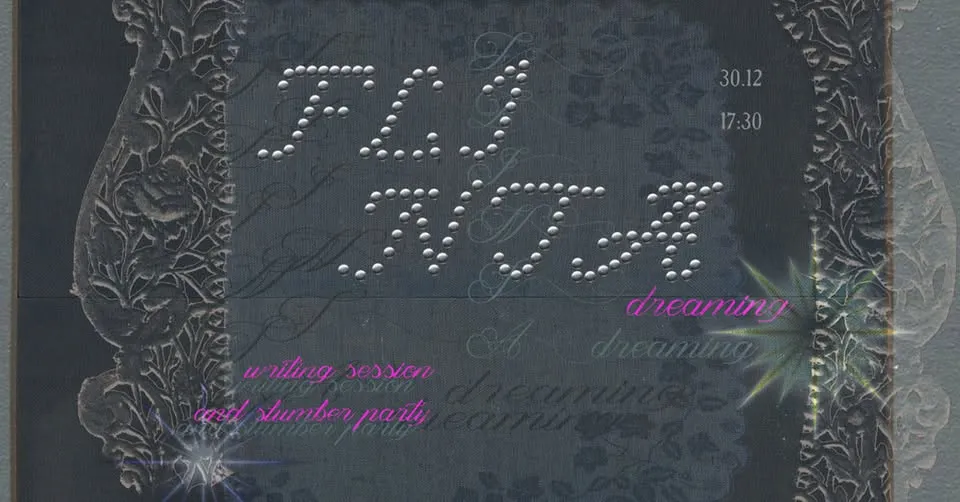
💌 FLINTA dreaming writing session and slumber party 🗓️ 30.12 Tuesday, 5:30 PM 📍 Zachęta | in the exhibition space 🔗 free admission, registration required: https://zacheta.art.pl/pl/kalendarz/flinta-dreaming 💤 The main languages of the event are English/Belarusian, but you can write and nap in any language. Hosted by: Varvara Sudnik and Viktoryia Hrabennikava One day before New Year's Eve we invite you to sleep inside a gallery. We will take one room out of the institutional hands of Zachęta and use it for rest and dreaming. At our slumber party we'll write dreams and try to dream it right there. We will not try to control dreams in any way. Instead, we want to experiment with a writing practice where stories follow dream logic(which sometimes means no clear logic at all). We will pick fragments of our memories, add people (who, of course, are not who they are), stretch and compress the experience of time, and place everything in the stairwell of your first home or into a school gym. We want to write dreams that can be a whole story or exist only as a fragment of flight, a moment of napping with half-open eyes. We'll also have some before-sleep herbal tea, sweets and gossip. At the end, you will have time to take a short nap and try to imagine your dream, and we will take care of it. The event is F female L lesbian I intersex N non-binary T trans A agender which means it's welcoming for women, lesbians and queer people. Here you'll feel safety and joyness of having a sleepover with your childhood girlfriends*. We are doing this event for ourselves, for those who see dreams, and for those who are already half-asleep because of the winter darkness. There are no required rules for participation - this is just a game. Unnecessary dress code: pajamas and nightgowns The main languages of the event are English/Belarusian, but you can write and nap in any language. This event is a part Mycelium [Грыбнiца] - decolonial laboratory and exhibition "What Are Our Collective Dreams?" Varvara Sudnik - a broke queer artist from Belarus, their work addresses the topics of exclusion and visibility, gender, labor, and trauma. Viktoryia Hrabennikava - Belarusian visual artist, researcher of culture and art. Queering, human and labor rights, representation of lesbian femininity and movement towards non-binary gender narratives, mental health - are the themes that are reflected in her works. Hrabennikava's artistic and activist practices intersect, outside their personal projects Viktoryia cooperates with NGOs and grassroots activist initiatives focused on human rights.
💌 FLINTA dreaming writing session and slumber party 🗓️ 30.12 Tuesday, 5:30 PM 📍 Zachęta | in the exhibition space 🔗 free admission, registration required: https://zacheta.art.pl/pl/kalendarz/flinta-dreaming 💤 The main languages of the event are English/Belarusian, but you can write and nap in any language. Hosted by: Varvara Sudnik and Viktoryia Hrabennikava One day before New Year's Eve we invite you to sleep inside a gallery. We will take one room out of the institutional hands of Zachęta and use it for rest and dreaming. At our slumber party we'll write dreams and try to dream it right there. We will not try to control dreams in any way. Instead, we want to experiment with a writing practice where stories follow dream logic(which sometimes means no clear logic at all). We will pick fragments of our memories, add people (who, of course, are not who they are), stretch and compress the experience of time, and place everything in the stairwell of your first home or into a...
Terminy
30 Grudnia 2025, Wtorek
16:30
Organizator
Z
Zachęta – Narodowa Galeria Sztuki to największa i najbardziej znana galeria sztuki współczesnej w Polsce. Przybliża publiczności prace uznanych artystów zagranicznych oraz aktywnie promuje polskich młodych twórców. Zachęta to też najstarszy salon wystawowy Warszawy, którego historia sięga 1860 roku, utworzony przez Towarzystwo Zachęty Sztuk Pięknych. Galeria mieści się w samym centrum Warszawy, w pięknym eklektycznym gmachu, który ocalał w czasie II wojny światowej. Poza inspirującymi wystawami oferuje bogaty program wydarzeń towarzyszących, w tym: spotkania z artystami, pokazy filmowe, koncerty, oprowadzania i warsztaty artystyczne dla dzieci, rodzin, pracowników firm, a także seniorów. Zachęta organizuje wystawy indywidualne i zbiorowe, w tym problemowe; kuratorzy galerii inicjują też i współtworzą ekspozycje sztuki polskiej za granicą. Dyrektor Zachęty jest komisarzem Pawilonu Polskiego w Wenecji na Międzynarodowej Wystawie Sztuki i Międzynarodowej Wystawie Architektury. W 2008 roku Polski Pawilon otrzymał najwyższą nagrodę Złotego Lwa za ekspozycję „Budynków życie po życiu”. Do najgłośniejszych ekspozycji zorganizowanych w Zachęcie, w ostatnich kilkunastu latach, należą: „Klasycy XX wieku”, „Słońce i inne gwiazdy”, „Nowa strefa. Sztuka chińska”, „Warszawa – Moskwa / Moskwa – Warszawa 1900–2000”, „czarny alfabet – konTEKSTY sztuki afroamerykańskiej”, „Rewolucje 1968”, „Inwazja dźwięku. Muzyka i sztuki wizulane”, „Płeć? Sprawdzam. Kobiecość i męskość w sztuce Europy Wschodniej”. „Pokolenie przemiany. Nowa sztuka z Indii”, a także wystawy przygotowane z myślą o dzieciach, jak: „Sztuka współczesna dla wszystkich dzieci”, „Arka Wilkonia”, „Lato w mieście. Wystawa nie tylko dla dzieci”, „Interaktywny plac zabaw”. W ramach wystaw indywidualnych zaprezentowaliśmy twórczość, m.in.: Tadeusza Kantora, Pawła Althamera, Daniela Libeskinda, Wilhelma Sasnala, Krzysztofa Wodiczki, Luca Tuymansa, Włodzimierza Pawlaka, Pawła Jarodzkiego, Zbigniewa Libery, Jakuba Juliana Ziółkowskiego, Jana Lebensteina, Anette Messager, Allana Sekuli, Katarzyny Kozyry, Wolfganga Tillmansa i wielu innych indywidualności XX i XXI wieku. Od 2003 roku, co dwa lata, Zachęta – wspólnie z Fundacją Deutsche Bank i Deutsche Bank Polska – organizuje konkurs i wystawę pokonkursową „Spojrzenia” dla najbardziej interesujących młodych twórców na polskiej scenie artystycznej. Ponadto galeria organizuje sympozja, dyskusje problemowe, warsztaty i spotkania promocyjne, przeglądy filmów, koncerty i inne wydarzenia towarzyszące wystawom. Ważnym elementem oferty Zachęty jest edukacja najmłodszych, ale też oferta dla osób starszych. Zarówno warsztaty rodzinne, jak spotkania dla seniorów (spotkania z artystami w cyklu Patrzeć / zobaczyć, czy warsztaty taneczne) cieszą się ogromną popularnością. Zachęta gromadzi dzieła polskiej sztuki współczesnej, tworząc własną kolekcję. Aktualnie zbiory obejmują blisko 3 500 obiektów.