
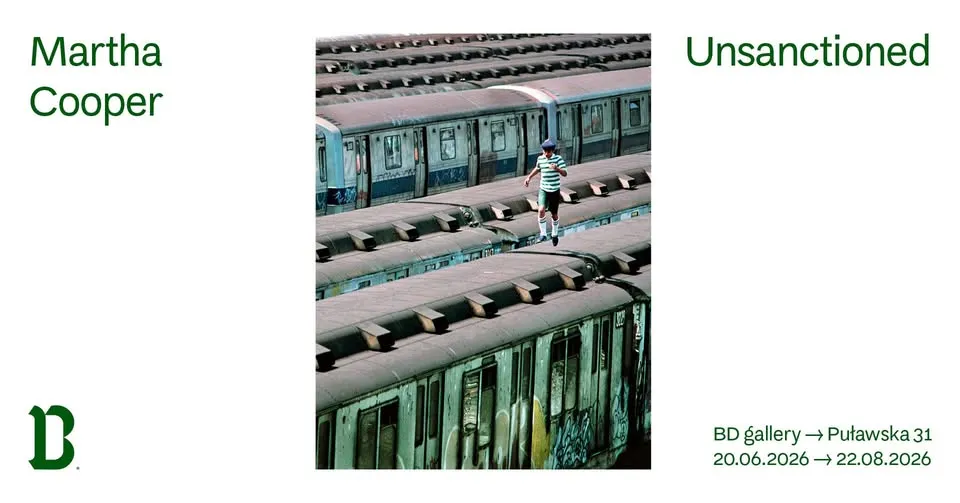
Martha Cooper | Unsanctioned | BD
Miejsce
Puławska 31, 02-508 Warsaw, Poland
ulica Puławska 31, 02-508 Mokotów, Polska
Cena
Bezpłatne
Opis
[English below] Martha Cooper | Unsanctioned Otwarcie wystawy z udziałem artystki: 20.06.2026 Sobota, 19:00 BD Gallery Puławska 31, Warsaw Wstęp wolny Martha Cooper to jedna z kluczowych postaci powojennej fotografii dokumentalnej w Stanach Zjednoczonych. Od ponad pięćdziesięciu lat dokumentuje praktyki twórcze społeczności działających poza ramami instytucji. Zanim wiele z nich zyskało publiczne uznanie, była tam ze swoim aparatem - rejestrując ich pracę, codzienne życie i światy, które przekształcały. Wystawa „Unsanctioned" prezentuje długoletnie zainteresowanie Cooper środowiskami, które wytwarzają własny język wizualny i praktyki kulturowe. Jej fotografie to nie tylko dokumentacja sztuki, ale przede wszystkim ludzi, którzy ją tworzą, a których działalność wykracza poza oficjalny obieg. Akt fotografowania jest u niej zawsze podwójny: zapisuje i jednocześnie współwytwarza kulturowe rozpoznanie tego, co rejestruje. Wystawę otwiera projekt „Tokyo Tattoo 1970", zrealizowany podczas pobytu Cooper w Japonii, gdzie uzyskała dostęp do studia mistrza tatuażu Horibuna I i udokumentowała tradycję irezumi - praktykowaną wówczas niemal wyłącznie w hermetycznym środowisku związanym z yakuzą. Już w tej wczesnej pracy widać postawę, która zdefiniuje całą jej drogę: fundamentem jest dostęp, obecność tam, gdzie nikt wcześniej nie był, i pozostanie na tyle długo, by obraz przestał być spojrzeniem z zewnątrz. Siedem lat później Cooper zostaje pierwszą kobietą na etacie fotoreporterki w historii „New York Post". Równolegle, poza zleceniami redakcji, realizuje „Street Play" (1977-1980) - w zaniedbanym Lower East Side fotografuje dziecięcą kreatywność: konstrukcje ze znalezionych materiałów, zabawy na dachach i ulicach, pierwsze podpisy na murach. Z perspektywy czasu te kadry nabrały znaczeń, których wówczas nikt im nie przypisywał - stały się obrazami aktywności rodzącej się z niedoboru, oporu ukrytego w geście zabawy, niewinności pośród rozpadu. Zainteresowanie kreatywnością wyłaniającą się z codzienności doprowadziło Cooper do nowojorskich społeczności skupionych wokół graffiti i rodzącej się wówczas kultury hip-hopowej. Tak powstała przełomowa książka „Subway Art" (1984, wspólnie z Henrym Chalfantem), która przyniosła globalny zasięg kulturze uznawanej wówczas za efemeryczną. Przez całą karierę Cooper pozostawała wierna swojej metodzie. Niezależnie od tematu - japońskiej tradycji tatuażu, dziecięcych zabaw, twórców graffiti czy społeczności miejskich na różnych kontynentach - cechowały ją wytrwałość i bliska obecność wśród ludzi, których fotografowała. „Unsanctioned" ukazuje drogę od pomijanych praktyk do rozpoznanych ruchów kulturowych. Jest zapisem dorobku, który pomógł utrwalić jedne z najbardziej wpływowych form kultury wizualnej naszych czasów. Kuratorzy wystawy: Cezary Hunkiewicz, Nika Kramer Projekt ekspozycji: Konrad Zamiar, realizacja: Jakub Antosz Identyfikacja wizualna: Konrad Smolarski Projekt współfinansuje miasto stołeczne Warszawa Wystawa czynna do 22 sierpnia, wtorek - sobota 12:00-19:00 Martha Cooper (ur. 1943, Baltimore) - jedna z kluczowych postaci powojennej fotografii dokumentalnej w Stanach Zjednoczonych. Absolwentka historii sztuki w Grinnell College oraz etnologii na University of Oxford. Pracowała jako kuratorka w dziale antropologii Uniwersytetu Yale, służyła w Korpusie Pokoju w Tajlandii i była fotografką National Geographic. W 1977 roku została pierwszą kobietą na etacie fotoreporterki w historii „New York Post". Od ponad pięciu dekad dokumentuje praktyki twórcze poza głównym obiegiem instytucjonalnym: od tradycyjnego tatuażu irezumi w środowisku yakuzy („Tokyo Tattoo 1970"), przez kultury czasu wolnego na Lower East Side („Street Play", 1977-1980), narodziny sztuki ulicznej i hip-hopu w Nowym Jorku („Subway Art", 1984; „Hip Hop Files", 2004), po antropologiczne studium kobiecości w fotografii reklamowej („Kodak Girl", 2011). Archiwum Cooper zostało włączone do zbiorów Library of Congress w Waszyngtonie. Jej fotografie znajdują się w kolekcjach Museum of the City of New York, Museum of Contemporary Art w Los Angeles, Pera Museum w Stambule oraz Urban Nation Museum w Berlinie, gdzie funkcjonuje stała „Martha Cooper Library". W 2015 roku jej prace pokazano na wystawie „Bridges of Graffiti" podczas 56. Międzynarodowej Wystawy Sztuki w Wenecji. W latach 2021-2022 Urban Nation Museum zaprezentowało „Martha Cooper: Taking Pictures", pierwszą pełną retrospektywę obejmującą ponad pięć dekad jej pracy. Bohaterka „Everybody Street" (2013) Cheryl Dunn, dokumentu o nowojorskiej fotografii ulicznej, w którym Cooper występuje obok Bruce'a Davidsona, Mary Ellen Mark, Elliotta Erwitta, Joela Meyerowitza i Jamela Shabazza. Bohaterka pełnometrażowego filmu „Martha: A Picture Story" (reż. Selina Miles, 2019), pokazanego na Tribeca Film Festival w Nowym Jorku. Autorka kilkunastu książek fotograficznych. Mieszka i pracuje w Nowym Jorku. BD Gallery - galeria sztuki współczesnej. Jej działalność obejmuje wystawy, projekty wydawnicze i program publiczny. Profil galerii wyrasta z wieloletniej praktyki dokumentacyjnej: systematycznego towarzyszenia formom wizualnym, które rozwijają się równolegle do świata instytucji i wytwarzają własne struktury dystrybucji, obiegu i krytyki. Projekty kuratorskie BD Gallery realizowane były m.in. w Warszawie, Paryżu, Berlinie, Sztokholmie, Wiedniu, Pradze, Mińsku i Kijowie. ----- Martha Cooper | Unsanctioned Opening in the presence of the artist: 20.06.2026 Saturday, 7 pm BD Gallery Puławska 31, Warsaw Free admission Martha Cooper is one of the key figures of post-war documentary photography in the United States. For more than fifty years, she has documented the creative practices of communities operating outside institutional frameworks. Long before many of them gained public recognition, she was there with her camera - recording their work, their everyday lives and the worlds they were transforming. The exhibition "Unsanctioned" traces Cooper's long-standing interest in communities that generate their own visual language and cultural practices. Her photographs document not so much art as, above all, the people who make it - people whose activity falls outside the official circuit. With Cooper, the act of photographing is always twofold: it records and, at the same time, helps produce the cultural recognition of what it records. The exhibition opens with "Tokyo Tattoo 1970", a project made during Cooper's stay in Japan, where she gained access to the studio of the tattoo master Horibun I and documented the tradition of irezumi - practised at the time almost exclusively within a closed milieu connected to the yakuza. Already in this early work one can see the stance that would define her entire path: its foundation is access, presence where no one had been before, and staying long enough for the image to cease being a view from the outside. Seven years later, Cooper became the first woman staff photographer in the history of the "New York Post". In parallel, beyond her editorial assignments, she made "Street Play" (1977-1980) - photographing children's creativity in the neglected Lower East Side: constructions built from found materials, games on rooftops and in the streets, the first signatures on walls. With time, these frames took on meanings no one ascribed to them then - they became images of activity born of scarcity, of resistance hidden in the gesture of play, of innocence amid decay. Her interest in creativity emerging from the everyday led Cooper to the New York communities centred around graffiti and the then-nascent culture of hip-hop. This is how her groundbreaking book "Subway Art" (1984, with Henry Chalfant) came about, bringing global reach to a culture then considered ephemeral. Throughout her career, Cooper has remained faithful to her method. Whatever the subject - the Japanese tattoo tradition, children's games, graffiti writers or urban communities on different continents - she has been defined by persistence and by a close presence among the people she photographed. "Unsanctioned" traces a path from overlooked practices to recognised cultural movements. It is a record of a body of work that has helped preserve some of the most influential forms of visual culture of our time. Exhibition curators: Cezary Hunkiewicz, Nika Kramer Exhibition design: Konrad Zamiar; production: Jakub Antosz Visual identity: Konrad Smolarski The project is co-financed by the City of Warsaw The exhibition is open until August 22, Tuesday-Saturday, 12:00 PM-7:00 PM. Martha Cooper (b. 1943, Baltimore) is one of the key figures of post-war documentary photography in the United States. She studied art history at Grinnell College and ethnology at the University of Oxford. She worked as a curator in the anthropology department at Yale University, served with the Peace Corps in Thailand and photographed for National Geographic. In 1977, she became the first woman staff photographer in the history of the "New York Post". For more than five decades she has documented creative practices outside the institutional mainstream: from traditional irezumi tattooing within the yakuza milieu ("Tokyo Tattoo 1970"), through the leisure cultures of the Lower East Side ("Street Play", 1977-1980) and the birth of graffiti and hip-hop in New York ("Subway Art", 1984; "Hip Hop Files", 2004), to an anthropological study of femininity in advertising photography ("Kodak Girl", 2011). Cooper's archive has been acquired by the Library of Congress in Washington, DC. Her photographs are held in the collections of the Museum of the City of New York, the Museum of Contemporary Art, Los Angeles, the Pera Museum, Istanbul, and the Urban Nation Museum, Berlin, home to the permanent "Martha Cooper Library". In 2015, her work was shown in "Bridges of Graffiti" at the 56th Venice Biennale. In 2021-2022, the Urban Nation Museum presented "Martha Cooper: Taking Pictures", the first full retrospective of her work, spanning more than five decades. She appears in Cheryl Dunn's "Everybody Street" (2013), a documentary on New York street photography, alongside Bruce Davidson, Mary Ellen Mark, Elliott Erwitt, Joel Meyerowitz and Jamel Shabazz, and is the subject of the feature-length documentary "Martha: A Picture Story" (dir. Selina Miles, 2019), which premiered at the Tribeca Film Festival in New York. She is the author of more than a dozen photography books. She lives and works in New York. BD Gallery is a contemporary art gallery. Its activities encompass exhibitions, publishing projects and a public programme. The gallery's profile has grown out of a long-standing documentary practice: a sustained engagement with visual forms that develop in parallel with the institutional world, generating their own structures of distribution, circulation and critique. BD Gallery has realised curatorial projects in Warsaw, Paris, Berlin, Stockholm, Vienna, Prague, Minsk and Kyiv, among other cities.
[English below] Martha Cooper | Unsanctioned Otwarcie wystawy z udziałem artystki: 20.06.2026 Sobota, 19:00 BD Gallery Puławska 31, Warsaw Wstęp wolny Martha Cooper to jedna z kluczowych postaci powojennej fotografii dokumentalnej w Stanach Zjednoczonych. Od ponad pięćdziesięciu lat dokumentuje praktyki twórcze społeczności działających poza ramami instytucji. Zanim wiele z nich zyskało publiczne uznanie, była tam ze swoim aparatem - rejestrując ich pracę, codzienne życie i światy, które przekształcały. Wystawa „Unsanctioned" prezentuje długoletnie zainteresowanie Cooper środowiskami, które wytwarzają własny język wizualny i praktyki kulturowe. Jej fotografie to nie tylko dokumentacja sztuki, ale przede wszystkim ludzi, którzy ją tworzą, a których działalność wykracza poza oficjalny obieg. Akt fotografowania jest u niej zawsze podwójny: zapisuje i jednocześnie współwytwarza kulturowe rozpoznanie tego, co rejestruje. Wystawę otwiera projekt „Tokyo Tattoo 1970", zrealizowany pod...
Terminy
20 Czerwca 2026, Sobota
17:00